Tampilkan postingan dengan label 21th century. Tampilkan semua postingan

Jumat, 07 Maret 2014

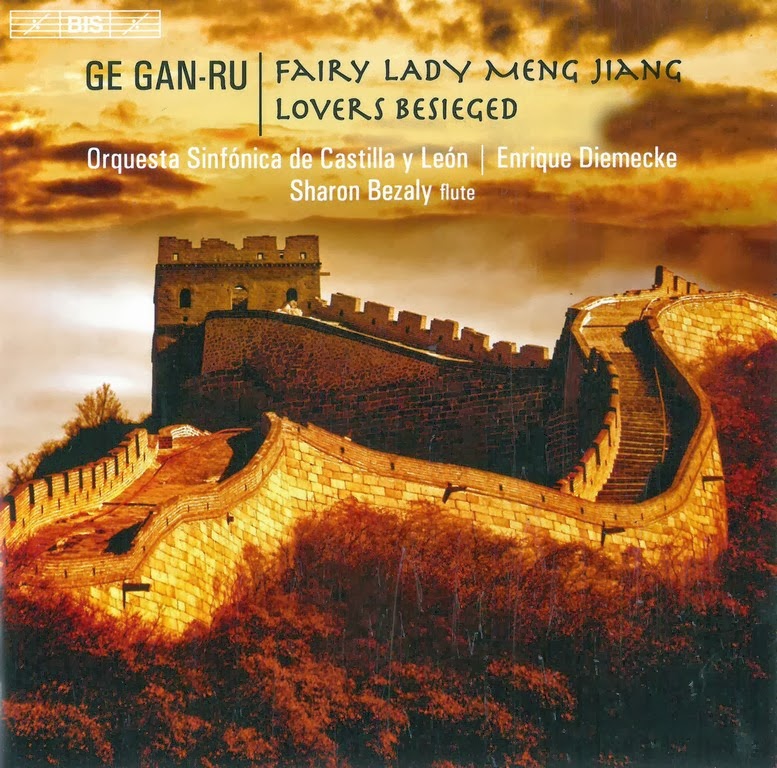
Ge Gan-Ru: Fairy Lady Meng Jiang


�Ge Gan-ru incorporates elements of traditional music and richly-scored late-Romanticism. Bezaly admirably meets the extraordinary demands of Meng Jiang.� --BBC Music Magazine, February 2014 ****

�For all of the gently artistry on show in the four-movement work that is Fairy Lady Meng Jiang the music is predominantly a vortex of the distraught and the anxious...This will broaden your horizons and introduce you to Ge, a composer...who is at ease working with the avant-garde and with the sentimentally eloquent.� --MusicWeb International, February 2014


Born in Shanghai in 1954, Ge Gan-ru grew up at a time when Western music was not heard in public, and could only be studied in secret. As the political and cultural atmosphere in China changed, Ge became one of the first students to enrol at the re-opened Shanghai Conservatory. There he was able to acquaint himself with the music of composers such as John Cage, George Crumb and Pierre Boulez, and it was at this time that he earned the designation �China�s first avant-garde composer�. Moving to New York in 1983, he continued his studies, with the expressed aim �to combine contemporary Western compositional techniques with my Chinese experience and Chinese musical characteristics�. A previous recording on BIS of Ge Gan-ru�s orchestral music impressed reviewers, with the website ClassicsToday.com remarking on the composer�s �immediately identifiable, intriguingly personal style�, �alternately exciting and ravishing� and �full of warmth and humour�.

The present disc combines two works which both proudly display their Chinese roots. The flute concerto Fairy Lady Meng Jiang is inspired by a classic Chinese fairy-tale, set in the 3rd century B.C. at the time of the building of the Great Wall and incorporating an element of magic as well as a dramatic love story with a deeply unhappy ending. The work is dedicated to Sharon Bezaly, the soloist on this recording, who also gave it its first performance together with the Orquesta Sinf�nica de Castilla y Le�n and Enrique Diemecke in March 2009. The same occasion saw the first performance of its companion piece, the orchestral suite Lovers Besieged which the composer developed from an earlier trio for cello, percussion and piano. Again the work is rooted in early Chinese history � in fact just a few years after the events befalling Meng Jiang � and again it is a story of love and death, now played out against a back-drop of war and insurrection during the collapse of the Qin dynasty.

Selasa, 04 Maret 2014

Banks: Seven


"Banks has a genuine melodic gift... The LPO under Mike Dixon play sympathetically and often ardently, and the woodwind relish Simon Hale��s many piquant touches of colour." --Gramophone, May 2004

"Fans of Tony Banks will be queuing to buy the album and it has 'chill out' possibilities for the post-party coterie." --MusicWeb International


"There's absolutely no reason why pop music writers should not attempt to compose large-scale orchestral works, and I applaud Tony Banks for making the effort...The performance as such sounds perfectly fine and is very well recorded; the London Philharmonic does a thoroughly creditable job under Mike Dixon. I don't think Naxos was wrong to go for this project; Banks has a following and his fans may enjoy it."--ClassicsToday.com

Rabu, 26 Februari 2014

Aho: Symphonic Dances 'Hommage � Uuno Klami', Symphony No. 11


�a superb coupling of two strongly communicative contemporary works�which demonstrate Aho�s comprehensive mastery of rhythm, timbre and drama. Again, the performance is a definitive one and BIS's engineering breathtaking in its realism.� --Gramophone, July 2004

Gramophone Magazine
Editor's Choice - July 2004


�Aho's Symphonic Dances (2001) bear the subtitle 'Hommage � Uuno Klami' � and therein lies the clue to the work's genesis. Klami (1900- 1961), one of the leading Finnish composers of the last century, had high hopes for his largescale, Kalevala-inspired ballet Pyr�rteit�, but by the time of his death had managed to orchestrate only the second of its three acts. Aho orchestrated Act 1 in 1988. During 2000, no material having come to light for the final act, he embarked on completing Klami's magnumopus, bolstered by the prospect of a production at the Finnish National Ballet. In the event, that belated premiere never materialised, and it was left to Osmo V�nsk� and the Lahti SO to champion Aho's 'Third Act' in the concert hall. A thoroughly approachable, 27-minute creation of exhilarating drive and colour, its four movements take their names from Klami's original synopsis. It's stunningly well served here by artists and production crew alike.

Symphony No 11 is almost as rewarding. It grew out of a commission for an orchestral work involving the Kroumata Percussion Ensemble, and is cast in three movements, the last of which distils a wondrous stillness and inner calm. It also serves as a perfect foil to the first two movements, both of which demonstrate Aho's comprehensive mastery of rhythm, timbre and drama. Again, the performance is a definitive one and BIS's engineering breathtaking in its realism.� --Gramophone Classical Music Guide, 2010

Jumat, 14 Februari 2014

The Red Violin: Concertos by Corigliano & Kuusisto


"Two splendidly enjoyable modern concertos superbly performed and in the finest sound... Another magnificent recording from BIS and the Lahti orchestra, this time of very recent music." --MusicWeb International, October 2013
 
�Kuusisto's own Concerto (2011) is a colourful and dramatic score...The finale's rhythmic drive and alternating lyricism are immensely appealing...Excellent performances and sound.� --Gramophone Magazine, October 2013


John Corigliano's violin concerto 'The Red Violin' originated as the score to a film about a violin by one of the Old Italian master-builders, and its journeys around the world throughout three centuries. While working on the film score, Corigliano also produced a one-movement concert version of it, which he later expanded into a full-scale concerto in four movements. The son of a violinist, Corigliano�s aim was to write a concerto in a style his father would have wanted to play, and he has managed to do so without sacrificing any of the music's communicative qualities, or its wealth of colours, emotions and atmospheres.

The work is coupled here with a concerto of a similar broad appeal, composed by Jaakko Kuusisto, who is a highly respected violinist in his own right, as well as conductor. In his liner notes, Kuusisto recounts how he had toyed with the idea of writing a violin concerto for several years, but that the project only came into fruition after a commission from his colleague Elina V�h�l�, and the liberating prospect of composing a work for another performer than himself. Appearing for the first time on BIS, the acclaimed violinist Elina V�h�la has a wide-ranging career, both geographically and in terms of repertoire. She made her d�but at the age of twelve, performing as a soloist with the Lahti Symphony Orchestra, which lends her spirited support on the present disc, and also performs the orchestral piece Leika. Using the Icelandic word for �play� as its title, Kuusisto�s composition displays a playfulness and wealth of colours that makes it a perfect curtain raiser for this appealing disc.

Rabu, 12 Februari 2014

J�rg Widmann: Violin Concerto


�In Christian Tetzlaff, Daniel Harding and the Swedish RSO, Widmann has found suitably uncompromising interpreters, and the recordings are as unvarnished and wide in perspective as the music itself demands.� --Gramophone Magazine, August 2013

�Widmann's Violin Concerto will appeal to those who like Berg's. Tetzlaff's performance is outstanding...An impressive collection.� --BBC Music Magazine, December 2013 ****


�[Tetzlaff's account is] so astonishingly vivid and secure that Widmann's impressive work at least has to share the spotlight with its dedicatee...Tetzlaff makes every second matter; one is carried along on the bleak journey Widmann invents� --The Guardian, 23rd May 2013 ****

Sabtu, 08 Februari 2014

Tony Banks: SIX Pieces for Orchestra

�Ex-Genesis member Tony Banks in classical mode, each of the six pieces majoring on rhapsodic feeling and bold melodies. Blade, featuring the solo violin of Charlie Siem, is the most impressive.� --BBC Music Magazine, June 2012 ****

�These six symphonic songs are full of openhearted melody and glamorous orchestration�Particularly pleasing is The Oracle, a serene bit of tunefulness that has harmonies, harps, and woodwind writing that sound a bit like early Delius. The orchestra has a big, brassy sound, with lush strings for the soupier lyrical moments�and there are plenty of those. Martin Robertson�s alto sax solos in Siren and Charlie Siem�s violin in Blade are smooth and stylish.� --American Record Guide, September 2012


Tony Banks, founder member of rock band Genesis, has already written a much admired orchestral work called Seven (8557466), in which he was praised for his �genuine melodic gift� (Gramophone). His new work consists of six evocative songs without words which may arouse in the listener ideas of seduction, journeys, heroes, quests, decisions and goals. Two of the pieces feature solo instruments � alto saxophone on Siren and violin on Blade � played here by elite soloists, which mesh into Banks�s orchestral tapestry with bewitching effect. The remaining pieces reveal his outstanding lyrical gifts and total command of musical narrative.

Tony Banks has a big following for his solo work outside the group. His classical compositions have been admired for their lyricism and melodic qualities, with some critics noting an affinity with the string works of Vaughan Williams.