Music is an art form whose medium is sound. Its common elements are pitch (which governs melody and harmony), rhythm (and its associated concepts tempo, meter, and articulation), dynamics, and the sonic qualities of timbre and texture. The word derives from Greek μουσική (mousike; "art of the Muses"). In its most general form the activities describing music as an art form
include the production of works of music, the criticism of music, the
study of the history of music, and the aesthetic dissemination of music.
The creation, performance, significance, and even the definition of music
vary according to culture and social context. Music ranges from
strictly organized compositions (and their recreation in performance),
through improvisational music to aleatoric forms. Music can be divided into genres and subgenres,
although the dividing lines and relationships between music genres are
often subtle, sometimes open to personal interpretation, and
occasionally controversial. Within the arts, music may be classified as a performing art, a fine art, and auditory art. It may also be divided among art music and folk music. There is also a strong connection between music and mathematics. Music may be played and heard live, may be part of a dramatic work or film, or may be recorded.
To many people in many cultures, music is an important part of their way of life. Ancient Greek and Indian philosophers
defined music as tones ordered horizontally as melodies and vertically
as harmonies. Common sayings such as "the harmony of the spheres" and
"it is music to my ears" point to the notion that music is often ordered
and pleasant to listen to. However, 20th-century composer John Cage thought that any sound can be music, saying, for example, "There is no noise, only sound."
Selasa, 17 Maret 2015

Minggu, 09 Maret 2014
Piazz�lla: Tango Distinto

�A swinging, sultry collection of arrangements of the Tango King's music showcasing the exception talent of Greek trombonist Achilles Liarmakopoulos.� --BBC Music Magazine, March 2012 ****
"Piazzolla�s music appears in a variety of arrangements, but this is claimed as the first recording with a trombone as the constant element. I don�t recall having encountered the young Greek trombonist Achille Liarmakopoulos before, but he�s a fine exponent of the music, in combination with a variety of other instruments. You probably already know if you like Piazzolla�s music�and it�s very hard to dislike. If you don�t, this is as good a way as any to get to know it�" --MusicWeb International, May 2011
"Piazzolla�s music appears in a variety of arrangements, but this is claimed as the first recording with a trombone as the constant element. I don�t recall having encountered the young Greek trombonist Achille Liarmakopoulos before, but he�s a fine exponent of the music, in combination with a variety of other instruments. You probably already know if you like Piazzolla�s music�and it�s very hard to dislike. If you don�t, this is as good a way as any to get to know it�" --MusicWeb International, May 2011

Legendary tango performer and composer Astor Piazzolla gained experience of jazz in New York and classical form and technique through studies with Alberto Ginastera. His work lends itself perfectly to arrangement for all kinds of ensemble, and this is the first recording with solo trombone. These popular pieces showcase the stunning playing of multi-award winning soloist Achilles Liarmakopoulos in a variety of moods, including the famous Oblivion, and Le Grand Tango, a virtuoso show-stopper originally written for cellist Mstislav Rostropovich.
Poenitz: Songs and Hymns with Harp

The second instalment of the Poenitz cycle on Brilliant Classics presents works for solo voice, accompanied by harp(s) and harmonium. The unique instrumental colours lend a special atmosphere to these intimate and deeply felt works, often on sacred texts. Franz Poenitz was not only a virtuoso on the harp (as is clearly evident in the rich and complex writing for his instrument in this music) but also an accomplished painter, one of his creations adorns the cover of the CD. New recording, with liner notes written by a descendant of Poenitz, Mr Andreas Fischer.

The first volume of the Poenitz Edition (works for solo harp played by Laura Vinciguerrra) is available on Brilliant Classic 94179. Born in 1850 in Bischofswerder, West Prussia (now Poland), Franz Poenitz made his name as a harpist, performing and touring as a child prodigy from the age of six, before spending most of his adult career as a chamber musician at the Berlin Royal Court Opera. He began studying composition when he was 11, and continued to write music throughout his career � focusing primarily on works for the harp and harmonium, of which he was also a virtuoso.
Although Poenitz�s compositions never achieved widespread fame and were forgotten during the course of the 20th century, this fantastic new collection demonstrates why his works � particularly those for harp � are experiencing a revival of interest. In the eight pieces, Poenitz�s experience as a virtuoso harpist is evident; he makes full use of the instrument�s timbre, colour and lyricism to create evocative music of great delicacy. In Spukhafte Gavotte (�Spooky� Gavotte), Heinrich Heine�s ghostly poem Maria Antoinette is depicted through a suitably eerie arrangement. Der Fischer sees Goethe�s ballad of the same title set in an unusual arrangement for harp and mezzosoprano, while the evocative Wikingerfahrt may have been inspired by Swedish stories about the Viking Frithiof. In all cases, Poenitz�s ability to write intuitively for the harp is clear, and given full expression by this accomplished group of performers. Featuring world premiere performances of a number of pieces, this new disc is an introduction to this forgotten composer, and will be of particular interest to harp music enthusiasts.
Although Poenitz�s compositions never achieved widespread fame and were forgotten during the course of the 20th century, this fantastic new collection demonstrates why his works � particularly those for harp � are experiencing a revival of interest. In the eight pieces, Poenitz�s experience as a virtuoso harpist is evident; he makes full use of the instrument�s timbre, colour and lyricism to create evocative music of great delicacy. In Spukhafte Gavotte (�Spooky� Gavotte), Heinrich Heine�s ghostly poem Maria Antoinette is depicted through a suitably eerie arrangement. Der Fischer sees Goethe�s ballad of the same title set in an unusual arrangement for harp and mezzosoprano, while the evocative Wikingerfahrt may have been inspired by Swedish stories about the Viking Frithiof. In all cases, Poenitz�s ability to write intuitively for the harp is clear, and given full expression by this accomplished group of performers. Featuring world premiere performances of a number of pieces, this new disc is an introduction to this forgotten composer, and will be of particular interest to harp music enthusiasts.
Cherubini: Arias & Overtures from Florence to Paris

�Schiavo displays a nimble coloratura technique, phrases elegantly and makes much of her words...The Tuscan period band Auser Musici are robust rather than specially subtle partners, with, as recorded, a distinctly abrasive string tone. But there is no doubting the energy and commitment of their playing.� --Gramophone Magazine, April 2012
�These are the first performances I have heard by Auser Musici, technically and musically a notably accomplished original-instrument ensemble. Its founder, Carlo Ipata, gives Cherubini's music his considerable all� --International Record Review, March 2012
�These are the first performances I have heard by Auser Musici, technically and musically a notably accomplished original-instrument ensemble. Its founder, Carlo Ipata, gives Cherubini's music his considerable all� --International Record Review, March 2012

�What really surprises here, however, is that the lofty master of the severely sculpted phrase kicked off his career by writing coloratura showstoppers of fashionable difficulty for the divas of his day...Schiavo's coloratura generates the thrill of an athlete leaping hurdles. But when she essays anything like a sustained line, you're aware of shallowness in the tone.� --The Guardian, 9th February 2012 ***
Sabtu, 08 Maret 2014
Onslow: Cello Sonatas

�These elegantly crafted Sonatas from 1820 combine some of the thematic rigour of Beethoven with the ornate virtuosity of Weber. These are strongly committed and highly expressive performances.� --BBC Music Magazine, May 2013 ****
"It is good to hear Maria Kliegel again. Her warm sound is a pleasure�[Kliegel and Tichmann] enjoy themselves with this expansive yet classically phrased music. Altogether, it is a worthwhile project well handled by all, including the engineers." --American Record Guide, July 2013
"It is good to hear Maria Kliegel again. Her warm sound is a pleasure�[Kliegel and Tichmann] enjoy themselves with this expansive yet classically phrased music. Altogether, it is a worthwhile project well handled by all, including the engineers." --American Record Guide, July 2013

"�Naxos really lucked out here with a pair of performers who seem to take an evident delight in playing these works�[Kliegel and Tichman] seem to really enjoy and understand this music, and their finely nuanced and often energetic interpretations make a really great case for it.
Kliegel and Tichman find exactly the right mood for each work, and you the listener are taken along for a very enjoyable ride. I cannot praise this disc highly enough. These are great works, and a fine addition to the repertoire of virtually any performing cellist or pianist who engages in chamber music." --Fanfare, July 2013
"The three cello sonatas on offer here show a sure-handed mastery of cello idiom (Onslow played the instrument) and a facility for composition that gives equal voice and musical interest to both cello and piano�these are substantial works as demanding technically to the performer as they are immediately attractive to the ear of the listener.
�all of this is realized by two very competent and obviously devoted performers, cellist Maria Kliegel and pianist Nina Tichman, who work together in stylistic accord and with just enough individual interpretive freedom to ensure a lively interactive dynamic." --ClassicsToday.com Read complete review
Passo di pena in pena

The cantata da camera genre enjoyed its Golden Era in the early eighteenth century in Italy, mainly in Rome, through the auspices of employers as Cardinals Ottoboni and Pamphiliij and the Marquis Ruspoli, who organized several Accademie in their homes, weekly meetings in which music, poetry and discussions about art or philosophy attracted the most important nobles of the city. The most distinguished of these Accademie saw the presence of the great composers of the time: the newcomer Handel, Alessandro Scarlatti, Gasparini, instrumentalists as Arcangelo Corelli and Domenico, the son of Alessandro Scarlatti ... The highlight of these meetings was the time of the performance of some cantate da camera by such great personalities.

The extraordinary artistic atmosphere that existed in the Accademie soon expanded to other cities in Italy and from there to the rest of Europe. Our recording aims to recreate the repertoire that was heard in these Accademie when the cantata genre had spread and had evolved, around 1730: from the wonderful style, nostalgic and always surprising of Alessandro Scarlatti to the lyricism of Bononcini, the glow and melodic treatment of the voice of Porpora or the rich sounds of Vivaldi, all seasoned with an instrumental Triosonata by Locatelli.
There are few occasions when a record producer has the great pleasure and honor to present a truly unique artist, as the Italian countertenor Flavio Ferri-Benedetti. In his recording debut, we fall in love with his beautiful voice, sensual, round and firm. He captures us with his wonderful way to say the text, to feel the emotions, with his perfectly - it could not be otherwise - shaped Italian. He gives each phrase, each word, its accurate meaning and draws from every note exactly what the listener wants to perceive, displaying an unusually brilliant technique. Flavio is joined in this extraordinary recording by the ensemble Il Profondo, a group specializing in the interpretation of the basso continuo, created by young musicians from different countries (Switzerland, France, Japan, Italy, Spain) formed in the prestigious Schola Cantorum Basiliensis. They offer a colorful accompaniment, robust, sensitive to every nuance, attentive to detail, a pleasure to the ears. Surely, all those who buy this CD will agree that they have rarely had the pleasure of listening to a countertenor recording of this technical and artistic level. We believe it will become a benchmark in the early music discography.
There are few occasions when a record producer has the great pleasure and honor to present a truly unique artist, as the Italian countertenor Flavio Ferri-Benedetti. In his recording debut, we fall in love with his beautiful voice, sensual, round and firm. He captures us with his wonderful way to say the text, to feel the emotions, with his perfectly - it could not be otherwise - shaped Italian. He gives each phrase, each word, its accurate meaning and draws from every note exactly what the listener wants to perceive, displaying an unusually brilliant technique. Flavio is joined in this extraordinary recording by the ensemble Il Profondo, a group specializing in the interpretation of the basso continuo, created by young musicians from different countries (Switzerland, France, Japan, Italy, Spain) formed in the prestigious Schola Cantorum Basiliensis. They offer a colorful accompaniment, robust, sensitive to every nuance, attentive to detail, a pleasure to the ears. Surely, all those who buy this CD will agree that they have rarely had the pleasure of listening to a countertenor recording of this technical and artistic level. We believe it will become a benchmark in the early music discography.
Jumat, 07 Maret 2014
Ge Gan-Ru: Fairy Lady Meng Jiang
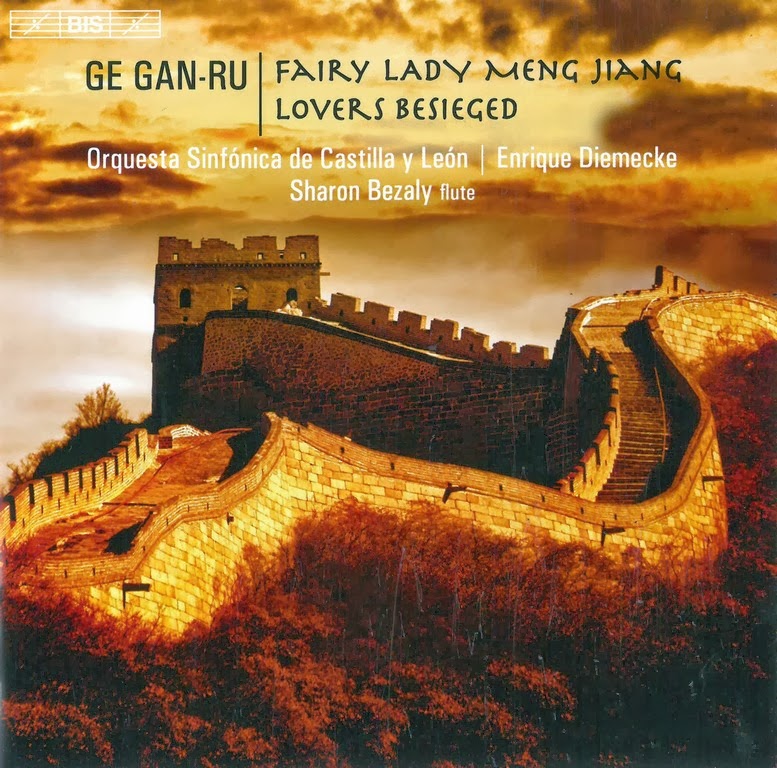
�Ge Gan-ru incorporates elements of traditional music and richly-scored late-Romanticism. Bezaly admirably meets the extraordinary demands of Meng Jiang.� --BBC Music Magazine, February 2014 ****
�For all of the gently artistry on show in the four-movement work that is Fairy Lady Meng Jiang the music is predominantly a vortex of the distraught and the anxious...This will broaden your horizons and introduce you to Ge, a composer...who is at ease working with the avant-garde and with the sentimentally eloquent.� --MusicWeb International, February 2014
�For all of the gently artistry on show in the four-movement work that is Fairy Lady Meng Jiang the music is predominantly a vortex of the distraught and the anxious...This will broaden your horizons and introduce you to Ge, a composer...who is at ease working with the avant-garde and with the sentimentally eloquent.� --MusicWeb International, February 2014

Born in Shanghai in 1954, Ge Gan-ru grew up at a time when Western music was not heard in public, and could only be studied in secret. As the political and cultural atmosphere in China changed, Ge became one of the first students to enrol at the re-opened Shanghai Conservatory. There he was able to acquaint himself with the music of composers such as John Cage, George Crumb and Pierre Boulez, and it was at this time that he earned the designation �China�s first avant-garde composer�. Moving to New York in 1983, he continued his studies, with the expressed aim �to combine contemporary Western compositional techniques with my Chinese experience and Chinese musical characteristics�. A previous recording on BIS of Ge Gan-ru�s orchestral music impressed reviewers, with the website ClassicsToday.com remarking on the composer�s �immediately identifiable, intriguingly personal style�, �alternately exciting and ravishing� and �full of warmth and humour�.
The present disc combines two works which both proudly display their Chinese roots. The flute concerto Fairy Lady Meng Jiang is inspired by a classic Chinese fairy-tale, set in the 3rd century B.C. at the time of the building of the Great Wall and incorporating an element of magic as well as a dramatic love story with a deeply unhappy ending. The work is dedicated to Sharon Bezaly, the soloist on this recording, who also gave it its first performance together with the Orquesta Sinf�nica de Castilla y Le�n and Enrique Diemecke in March 2009. The same occasion saw the first performance of its companion piece, the orchestral suite Lovers Besieged which the composer developed from an earlier trio for cello, percussion and piano. Again the work is rooted in early Chinese history � in fact just a few years after the events befalling Meng Jiang � and again it is a story of love and death, now played out against a back-drop of war and insurrection during the collapse of the Qin dynasty.
The present disc combines two works which both proudly display their Chinese roots. The flute concerto Fairy Lady Meng Jiang is inspired by a classic Chinese fairy-tale, set in the 3rd century B.C. at the time of the building of the Great Wall and incorporating an element of magic as well as a dramatic love story with a deeply unhappy ending. The work is dedicated to Sharon Bezaly, the soloist on this recording, who also gave it its first performance together with the Orquesta Sinf�nica de Castilla y Le�n and Enrique Diemecke in March 2009. The same occasion saw the first performance of its companion piece, the orchestral suite Lovers Besieged which the composer developed from an earlier trio for cello, percussion and piano. Again the work is rooted in early Chinese history � in fact just a few years after the events befalling Meng Jiang � and again it is a story of love and death, now played out against a back-drop of war and insurrection during the collapse of the Qin dynasty.
Rabu, 05 Maret 2014
Wagner: Symphonic Syntheses by Stokowski

��truly beautiful performance that, as far as I know, is now only available from the orchestra itself as part of a larger set in honor of its centennial�Stokowski performance wise and is blessed with superior sound. Serebrier�s is relaxed and sensuou If you should come upon this CD, do not judge it by its�cover art�if this sort of thing is your dish, it�s quite delicious.� --Fanfare, February 2008
�Fine performances, revivifying these pioneering pieces.� --BBC Music Magazine, December 2007 ****
�Fine performances, revivifying these pioneering pieces.� --BBC Music Magazine, December 2007 ****

�It would be hard to imagine a more sumptuous disc. Stokowski, in these 'symphonic syntheses', enhances Wagner's already opulent orchestration with shrewdly added instrumental lines and with the vocal parts usually given to the strings.
Then at times he thins the orchestration down for more transparent textures. Jos� Serebrier conducts the Bournemouth SO in thrilling performances, passionate in a genuinely Stokowskian manner and treated to orchestral sound of demonstration quality.
Stokowski's aim was to provide more satisfying orchestral items in concerts than the popular 'bleeding chunks'. So in the most ambitious item, on Tristan, we have between the Prelude and Liebestod a rich orchestral version of the Love Duet. Where the end of the duet builds up to that chilling interruption from King Marke, Stokowski has it lead seamlessly into the equivalent passage in the Liebestod. It works superbly.
The selection starts excitingly with the Entry of the Gods into Valhalla and it is good to find Serebrier splendidly adding an anvil when Donner brings his hammer down. The Parsifal synthesis is limited to music from Act 3, thus ignoring the Good Friday Music. From DieWalk�re comes the Magic Fire Music and, most excitingly, the Ride of the Valkyries. This is the finest of Naxos's Stokowski discs to date.� --Gramophone Classical Music Guide, 2010
Selasa, 04 Maret 2014
Banks: Seven

"Banks has a genuine melodic gift... The LPO under Mike Dixon play sympathetically and often ardently, and the woodwind relish Simon Hale��s many piquant touches of colour." --Gramophone, May 2004
"Fans of Tony Banks will be queuing to buy the album and it has 'chill out' possibilities for the post-party coterie." --MusicWeb International

"There's absolutely no reason why pop music writers should not attempt to compose large-scale orchestral works, and I applaud Tony Banks for making the effort...The performance as such sounds perfectly fine and is very well recorded; the London Philharmonic does a thoroughly creditable job under Mike Dixon. I don't think Naxos was wrong to go for this project; Banks has a following and his fans may enjoy it."--ClassicsToday.com
Minggu, 02 Maret 2014
Bach Sonatas and Partitas for Violin Solo, BWV 1001-1006 (Guitar Version)

Born in the Japanese port city of Nagasaki, in 1961, Kazuhito Yamashita is widely recognized as one of the world's most premier virtuoso guitarists. His dazzling technique and powerful expression has received accolades throughout the musical world. With an impressive list of almost 80 recordings and numerous original arrangements of such works as Mussorgski's Pictures at an Exhibition, Stravinsky's Firebird, Rimsky-Korsakov's Scherezade and Dvorak's Symphony of the New World, Yamashita is a legend within guitar circles.

Handel: Harpsichord Works, Volume 2

�Sophie Yates confirms her credentials as one of Britain�s most talented harpsichordists �Yates has a neat, agile technique, phrases thoughtfully, with a restrained but telling use of rubato and ornamentation, and brings plenty of zest to the gigues and courantes. A disc to whet the appetite for further volumes in the series.� --The Daily Telegraph on CHAN 0644 (Handel Harpsichord Works Vol. 1)
�Yates plays her well-chosen selection with great subtlety and sparkle.� --Gramophone on CHAN 0659 (Rameau)
�Yates plays her well-chosen selection with great subtlety and sparkle.� --Gramophone on CHAN 0659 (Rameau)

Sabtu, 01 Maret 2014
Biber: Harmonia Artificiosa-ariosa

The music of Biber is widely assumed to have gone out of vogue with violinists before the middle of the eighteenth century. Biber's reputation, however, lived. In 1789 Charles Burney wrote in his "General History of Music", "of all the violin players of the last century, Biber seems to have been the best, and his solos are the most difficult and most fanciful of any music I have seen of the same period." Biber's Harmonia artificioso-ariosa (1696) is a collection in seven parts (partias), each employing a different tuning.

The Very Best of Adagio

". . . el sonido pur�simo y �nico de la Deutsche y la multidimensionalidad de la Filarm�nica de Berlin comparten espacio con grabaciones de cortar la respiraci�n, pertenecientes a los dominios que mejor conoc�a el director." --Record Review, Mel�mano (Madrid), 1 February 2006
Includes work(s) by various composers. Ensemble: Berlin Philharmonic Orchestra. Conductor: Herbert von Karajan.

Kamis, 27 Februari 2014
The Art of the Baroque Trumpet � Vol. 5

"[Eklund's] virtuoso skills, consistently sweet tone, purity of intonation, and sense of ease rank him as the world's best." --American Record Guide, August 2002
Reviewing the first volume in Naxos's "The Art of the Baroque Trumpet", Gramophone magazine said of Eklund, "let me rejoice at playing of rare technical ability and musical panache."
Reviewing the first volume in Naxos's "The Art of the Baroque Trumpet", Gramophone magazine said of Eklund, "let me rejoice at playing of rare technical ability and musical panache."

Rabu, 26 Februari 2014
Aho: Symphonic Dances 'Hommage � Uuno Klami', Symphony No. 11

�a superb coupling of two strongly communicative contemporary works�which demonstrate Aho�s comprehensive mastery of rhythm, timbre and drama. Again, the performance is a definitive one and BIS's engineering breathtaking in its realism.� --Gramophone, July 2004
Gramophone Magazine
Editor's Choice - July 2004
Gramophone Magazine
Editor's Choice - July 2004

�Aho's Symphonic Dances (2001) bear the subtitle 'Hommage � Uuno Klami' � and therein lies the clue to the work's genesis. Klami (1900- 1961), one of the leading Finnish composers of the last century, had high hopes for his largescale, Kalevala-inspired ballet Pyr�rteit�, but by the time of his death had managed to orchestrate only the second of its three acts. Aho orchestrated Act 1 in 1988. During 2000, no material having come to light for the final act, he embarked on completing Klami's magnumopus, bolstered by the prospect of a production at the Finnish National Ballet. In the event, that belated premiere never materialised, and it was left to Osmo V�nsk� and the Lahti SO to champion Aho's 'Third Act' in the concert hall. A thoroughly approachable, 27-minute creation of exhilarating drive and colour, its four movements take their names from Klami's original synopsis. It's stunningly well served here by artists and production crew alike.
Symphony No 11 is almost as rewarding. It grew out of a commission for an orchestral work involving the Kroumata Percussion Ensemble, and is cast in three movements, the last of which distils a wondrous stillness and inner calm. It also serves as a perfect foil to the first two movements, both of which demonstrate Aho's comprehensive mastery of rhythm, timbre and drama. Again, the performance is a definitive one and BIS's engineering breathtaking in its realism.� --Gramophone Classical Music Guide, 2010
Symphony No 11 is almost as rewarding. It grew out of a commission for an orchestral work involving the Kroumata Percussion Ensemble, and is cast in three movements, the last of which distils a wondrous stillness and inner calm. It also serves as a perfect foil to the first two movements, both of which demonstrate Aho's comprehensive mastery of rhythm, timbre and drama. Again, the performance is a definitive one and BIS's engineering breathtaking in its realism.� --Gramophone Classical Music Guide, 2010
Var�se: Ameriques, Arcana, Deserts, Ionisation

The whole of Var�se�s surviving output can be comfortably accommodated on a pair of CDs, as it is in Riccardo Chailly�s superlative survey on Decca, but Pierre Boulez�s single disc concentrates on the two orchestral works that Var�se wrote in the years after he emigrated to the United States in 1915, Am�riques and Arcana. Boulez is totally in his element in music like this, observing every teeming detail, controlling the massive up-wellings of sound with maximum assurance, and in the Chicago Symphony he has an orchestra that has all the virtuosity and panache to deliver it at maximum voltage.

Christopher Lyndon-Gee�s account of Arcana pales by comparison; there is neither enough security or weight of tone in the playing to compete on any level. The Naxos disc also includes equally cautious performances of the three pungent ensemble pieces of the Twenties, and Var�se�s final orchestral work, D�serts, in which he made one of the first attempts at combining electronic music with live performers. The tape sounds rather faded now, and it is not surprising that Boulez opts for the version of the score omitting the pre-recorded interludes, and makes a thing of wonder out of its intricate play of colours and textures.The only puzzle is why it has taken DG more than five years to release this outstanding collection.
Performance: 5 (out of 5), Sound: 5 (out of 5)
-- Andrew Clements, BBC Music Magazine
Performance: 5 (out of 5), Sound: 5 (out of 5)
-- Andrew Clements, BBC Music Magazine
Selasa, 25 Februari 2014
Taneyev: Suite de concert & Ioann Damaskin

Inspired by a poem by Aleksey Tolstoy, Taneyev�s cantata John of Damascus was the first work that the self-critical Russian composer deemed worthy of an opus number, its sublime music drawing on an ancient sacred chant woven into rich passages of expressive counterpoint. A quarter of a century later, the virtuosic and scintillating Suite de concert, Taneyev�s first work for solo violin and orchestra, was also successfully premi�red.

Suite de concert, written in 1909, is a novel, if rather disorganized, approach to a Romantic violin concerto. It�s an unusual conflation of serenade, neo-Baroque suite, and theme and variations that�in the hearing of it�seems to divide into movements or sections: an introductory Prelude, followed by a scherzo-like Gavotte, and then a slowish �Fairy Tale� movement marked Andantino. These three movements, in turn, set the stage, none too convincingly, for a theme and six variations with an extended variation-coda. But that�s not the end of this identity-confused work. The grand finale is a spirited Tarantella. In terms of style, I suppose some of the writing is suggestive of Glazunov�s A-Minor Violin Concerto that preceded the Suite de concert by five years; but there�s a passage beginning at 2:49 in the �Fairy Tale� movement that bears an uncanny resemblance to Chausson�s Po�me for violin and orchestra , written in 1896. It has long been the composer�s most widely known and recorded piece�Russian violinist Ilya Kaler has been one of Naxos�s long time and most dependable house artists, having recorded a respectable cross section of the Romantic violin repertoire. While Taneyev�s piece is no salon morceau, neither is it a virtuosic vehicle like the almost exactly contemporary Glazunov and Sibelius concertos. Kaler�s rounder tone and less excitable approach work well in the Taneyev, and I prefer his performance to that of Gringolts [on Hyperion].
When it comes to the cantata, Ioann Damaskin, Naxos[�s recording, with�] its Russian chorus, orchestra, and conductor� sounds convincingly authentic�At Naxos�s budget price, though, I�d say the new CD is well worth the modest investment. --Fanfare, March 2010
When it comes to the cantata, Ioann Damaskin, Naxos[�s recording, with�] its Russian chorus, orchestra, and conductor� sounds convincingly authentic�At Naxos�s budget price, though, I�d say the new CD is well worth the modest investment. --Fanfare, March 2010
Minggu, 23 Februari 2014
Villa-Lobos: Piano Music

'Magnificent. Easily the most sophisticated Villa-Lobos piano disc currently in the catalogue.' --International Record Review
'Marc-Andr� Hamelin�s transcendental sheen and facility bless everything he plays. He makes As tr�s Marias wink and scintillate with an inimitable verve � leaves all others standing.' --Gramophone
'Hamelin presents another hour of hair-raising (not to say spine-tingling) music in performances few could match � awesome.' --Classic CD

'An impressive disc' --BBC Music Magazine
�Enough technical dazzle to satisfy even the most virtuoso-hungry listeners� --Fanfare, USA
'Revelatory. In short, this is a must-buy release. It�s thrillingly exciting. Recommended with all possible enthusiasm' --Fanfare, USA
'Hamelin grasps [the music�s] sprawl clearly and delivers it with unrivalled perfection of pianistic mechanism. He relishes the delights of the lighter pieces with equal virtuosity' --Irish Times
�Marvellously iridescent in these magnificent interpretations � a fantastically varied succession of miniatures that will hardly fail to please� --The Magic Flute
Sabtu, 22 Februari 2014
Barber, Khachaturian: Violin Concertos

�Simonyan is a true virtuoso; his playing has a natural, unforced authority and, among other accomplishments, his clear, brilliant spiccato bowing is heard to great effect in the finales of both concertos...this is a performance [of the Barber] of notable power, Simonyan's confident presence - aided by strong support from Kristjan J�rvi and the LSO - generating considerable intensity as the climactic moments approach...All in all, a most impressive debut.� --Gramophone Magazine, February 2012

�Simonyan's intention was to bring out the qualities that embody the cultural roots of each composer: thus, he commissioned a new cadenza for Khachaturian's concerto by Artur Avanesov, to emphasise the Armenian flavour, and treated the dashing final movement of Barber's concerto in a looser manner than usual, suggestive of rustic American fiddling.� --The Independent, 20th January 2012
Liszt: Piano Concerto No. 1, Etc

To celebrate Franz Liszt�s bicentenary, Lang Lang has selected some of the most famous, virtuosic and poetic solo pieces ever written for the piano, concluding with a fabulous new recording of the Piano Concerto No. 1 � accompanied by the Vienna Philharmonic and Valery Gergiev.
Alternating the lyrical Liszt with the bravura, Lang Lang�s tribute to his �piano hero� mixes old favourites with some lesser-known pieces, transcriptions with original works � and rounds off with the high octane First Piano Concerto.
Alternating the lyrical Liszt with the bravura, Lang Lang�s tribute to his �piano hero� mixes old favourites with some lesser-known pieces, transcriptions with original works � and rounds off with the high octane First Piano Concerto.

To celebrate the 200th anniversary of Franz Liszt's birth, virtuoso pianist Lang Lang has selected some of the composer's most characteristic pieces for his 2011 Sony release, Liszt: My Piano Hero. Prominent on this album is the Piano Concerto No. 1 in E flat major, which features Lang Lang in a high-energy performance with Valery Gergiev and the Vienna Philharmonic. Without a doubt, most of Lang Lang's fans will savor this Romantic showpiece, and for technical brilliance and drama, the performance doesn't disappoint.
He is especially lively and vivid in this work, and his interactions with the orchestra seem spontaneous and playful, as one might well imagine Liszt would have been. But Lang Lang seems more introspective and personally involved with the solo keyboard pieces that make up the greater part of the album. Here also is the flashy side of Liszt, but there is a greater emphasis on the poetic and rhapsodic, so Lang Lang indulges in reflective pieces as much as the flashy encores. Highlights include La Campanella, the Grand Galop chromatique, Liebestraum No. 3, the Hungarian Rhapsody No. 6, and the arrangement of Schubert's Ave Maria.
Langganan:
Postingan (Atom)