Jumat, 10 Januari 2014

Great Baroque Masterpieces (10-CD Box Set)


Baroque music describes the period in Western classical music dating from approximately 1600 to 1750. The Baroque period saw the development of functional tonality, as well as new instrumental playing techniques and musical notation. It was during this time that opera was established as a musical genre, and the period also saw the expansion of the range and complexity of instrumental performance.


This collection concentrates on the instrumental music of the period. No survey of the Baroque would be complete without the music of JS Bach, whose Brandenburg concertos are commonly regarded as the apex of Baroque music. The radiant concertos of Vivaldi demonstrate the exhilarating range of instrumental colour that flourished at this time and contrast with the orchestral zest of Handel�s robust Water Music. From classical favourites such Pachelbel�s Canon and Albinoni�s Adagio, to Concerti Grossi from composers as diverse as Corelli, Handel, Locatelli and Geminiani, this set is the perfect compilation of works from this most fascinating of eras.

Selasa, 07 Januari 2014

Music for Cello & Piano

�This blissfully unhackneyed and brilliantly executed recital takes memory in all its facets as its theme...the recording throughout gives the players all the space and atmosphere they need to characterise the varied moods and textures of an unusually rewarding programme.� --Gramophone, Awards Issue 2012

�Match [Ades's playing] with the mellow sound and manner of Steven Isserlis's cello, and you have something very special. Their choice of repertory here - devised as an extended upbeat to Ades's Lieux retrouves at the end of the programme - is unusual, memorable, and wonderfully performed from start to finish.� --BBC Music Magazine, December 2012 *****


A cello recital with a difference from two maverick geniuses, displaying the fecundity of their collaboration. The world-famous cellist Steven Isserlis, one of the best-loved instrumentalists of today, joins forces with composer and pianist Thomas Ad�s, described by the New York Times as one of the most imposing figures in contemporary music.

This recording opens with three of Liszt�s arrangements for cello and piano�the dark plangency of Isserlis�s tone emphasizing their elegiac power. Jan�cek�s Poh�dka (�A Tale�) is based on a story with many magical elements, and it is this particular quality which Isserlis and Ad�s bring out in their aerial performance. The passionate ecstasy of Faur�s Cello Sonata No 2 is deeply felt, and the elemental mysterious sadness of Kurt�g�s miniatures leads the listener into the 21st century and to the �title track� of this disc which Ad�s wrote for Isserlis himself. Lieux retrouv�s is a characteristically thrilling tour de force, displaying influences from all the composers previously featured and many more. The writing for the cello reaches uncharted levels of difficulty. Isserlis in his thoughtful booklet notes describes it in pictorial terms of rivers and mountains�here�s Anthony Tommasini, again in the New York Times: �The rippling figures for piano and cello spin out in crazed, cyclic riffs; the crystalline piano harmonies sound as if the wind were rustling the chimes in the pagoda; the feisty, industrialized propulsive bursts in the finale.�

Minggu, 05 Januari 2014

Casella: Orchestral Works Volume 3

�The BBC Philharmonic is an outstanding orchestra who maintain excellent form throughout. Their playing of these multicoloured works is ideal. I love the way they can easily generate thrusting intensity then seamlessly shift to episodes of tender serenity. Noseda�s stunning interpretation of the Symphony makes a splendid case for this marvellous work� MusicWeb International, 15th July 2013
 
�This is attractive music and the BBC Philharmonic under Noseda are strong advocates.� BBC Music Magazine, October 2013 ****

Gramophone Magazine Editor's Choice - August 2013


�Noseda encourages the BBC Philharmonic to give of their considerable best throughout) the exuberant yet marvellously controlled orchestral playing towards the close of Italia really does raise the roof)...A very strong recommendation.� Gramophone Magazine, August 2013

�The performances are exceptional: even by their own standards, Noseda and the BBC Philharmonic have done nothing finer.� The Guardian, 13th June 2013 *****

�Those who have been following Noseda�s Casella series will be keen to add this disc to the collection...There is a whole spectrum of influences at work on Casella, but they are subsumed into a personal, dynamic style that the BBC Philharmonic conveys with sinew and spirit.� The Telegraph, 20th June 2013 ****

Jumat, 03 Januari 2014

Sarasate


The dazzling showpieces of violin legend Pablo Sarasate meet their match in Julia Fischer, one of the most sought-after musicians of her generation, delivering virtuoso pyrotechnics in a stunning recital disc.

The key track is Sarasate�s most celebrated composition: Zigeunerweisen (�Gypsy Airs�). With its heady czardas rhythms and folk flavour, it is best known as a showpiece for violin and orchestra, but Fischer and her long-standing accompanist Milana Chernyavska present it here as it was originally written, for violin and piano.


Fischer�s programme also includes the popular Danzas espanolas. Designed to show off technique, these captivating pieces soon became a top choice for violin encores.

Fischer�s recording will help shine a new light on Sarasate�s music, which she wants to restore to the concert platform. She feels that each of the pieces is a little gem with a mood and story all its own, and says that she wants to communicate the joy and enthusiasm of pieces that make people want to dance or sing.

Sarasate�s contemporaries held him in extremely high regard, with Camille Saint-Saens, Max Bruch and Edouard Lalo all dedicating works to him. He was one of the first violinists to leave acoustic recordings in the pioneering years of the 20th century, recording his Zigeunerweisen in 1904, and his extraordinary writing remains a supreme challenge to violinists over a century after his death in 1908.

Mahler: Symphony No.1


�an undeniably fresh and often startling performance...Jurowski 'hears' everything but better yet the reasons for everything. His precipitous way with tempo contrasts creates moments of high drama in the outer movements...if ever there was a case for wanting the roar of applause, this is it.� --Gramophone Magazine, June 2013

�Everything about the dewy dawn of this Mahler One is perfect...But as the hero...steps into the sunshine, the effect of the airless, in-your-face strings is rather oppressive...the point and spirit of the finale are dazzling, the tempo changes masterly throughout.� BBC Music Magazine, July 2013 ****


�Jurowski�s vivid reading...announces its intentions early on with the clarinet�s startlingly physical cuckoo call, and is exceptionally faithful to the Berliozian separation of timbres that was Mahler�s response to the blended textures of Austro-German music.� --Sunday Times, 2nd June 2013

�This is an extraordinarily sensitive and nuanced account which eschews the temptation to stick to the sunny-side and run blithely through the score. There are frequent, telling adjustments in the phrasing which never sound fussy or applied...I look forward to more of Jurowski's Mahler with the LPO; this recording is a triumph.� --MusicWeb International, 30th July 2013

Kamis, 02 Januari 2014

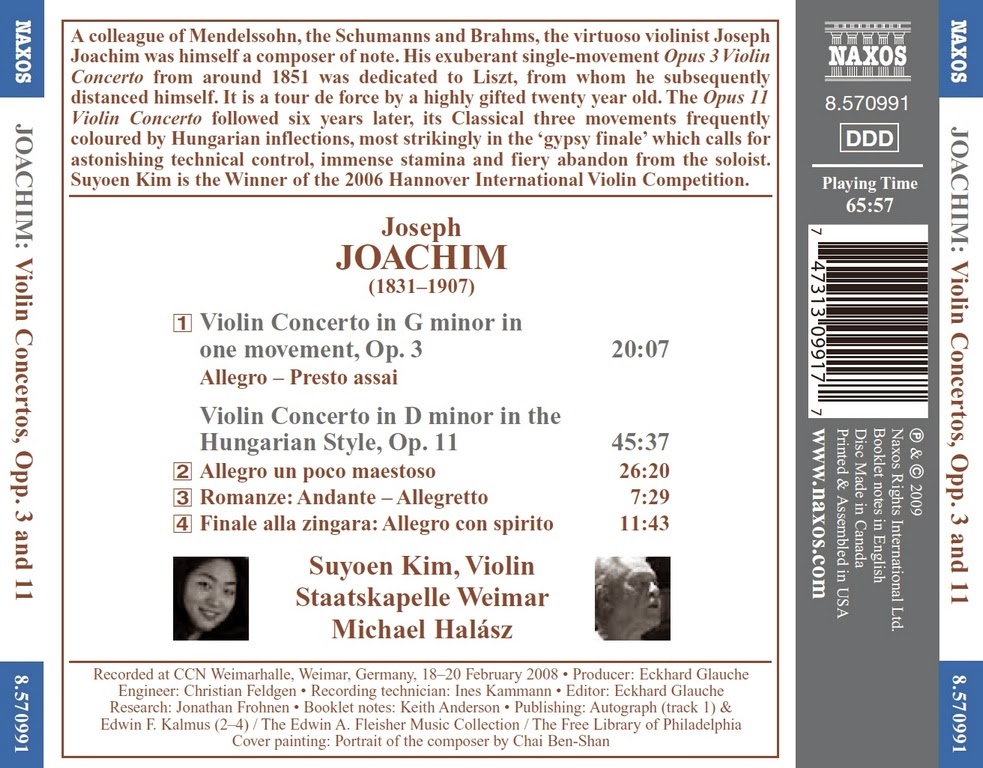
Joachim: Violin Concertos


"Joachim integrated the violin�s first entry into the opening tutti, after which initial statement the orchestra continues on its own. The solo part offered its youthful composer a great number of opportunities for virtuoso display�In its harmonic and melodic style, so heavily tinged with nostalgia�

�in the Hungarian style� has been described as the most difficult of concerted works for the violin�it requires strength and stamina as well as sustained brilliance, demanding a very occasional sacrifice of tonal beauty to achieve the requisite tonal strength. Strongly recommended to all kinds of listeners." --Fanfare, May 2010


A colleague of Mendelssohn, the Schumanns and Brahms, the virtuoso violinist Joseph Joachim was himself a composer of note. His exuberant single-movement Opus 3 Violin Concerto from around 1851 was dedicated to Liszt, from whom he subsequently distanced himself. It is a tour de force by a highly gifted twenty year old. The Opus 11 Violin Concerto followed six years later, its Classical three movements frequently coloured by Hungarian inflections, most strikingly in the �gypsy finale� which calls for astonishing technical control, immense stamina and fiery abandon from the soloist. Suyoen Kim is the Winner of the 2006 Hannover International Violin Competition.

Rabu, 01 Januari 2014

Prokofiev 3 & Bart�k 2


 �Immediately [the Prokofiev] explodes into life with Lang Lang�s sparkling playing with seemingly boundless reserves of energy...Outstanding in the opening [of the Bart�k] is Lang Lang�s rhythmic potency borders on the demonic...Under the baton of Sir Simon Rattle the Berliner Philharmoniker is highly persuasive and sympathetic. Not for the first time the woodwind excel - marvellous.� --MusicWeb International, November 2013


�How smart of Sony to have recorded [Lang Lang] in repertoire which plays to his strengths. This Prokofiev 3 is exceptionally good � thunderous when it needs to be, and always rhythmically alert. And Simon Rattle is a supremely effective partner...[the Bart�k] makes for an unexpected, rewarding coupling.� --The Arts Desk, 12th October 2013
�Lang Lang has the necessary power and athleticism to bring tremendous energy and drive to [Prokofiev's] more motoric writing...[he] sails through the passagework [of the Bartok] with exemplary clarity...The problem in the outer movements rests with the pianist's tendency to make everything sound harsh and percussive� --BBC Music Magazine, December 2013 ****

�Lang Lang gives a persuasive account of the Prokofiev. His finely observed detail..., the full use of the piano's sumptuous sonority and dynamic range and his effortless technical mastery would excite anyone's admiration...[in the Bartok] Lang Lang and Rattle are hugely impressive but, for my taste, a shade too polite.� --Gramophone Magazine, November 2013