Sabtu, 06 Juli 2013

Ghedini: Architetture & Contrappunti


Architetture (�Architectures�), a concerto for orchestra in seven linked sections, was the piece that catapulted the Italian composer Giorgio Federico Ghedini to fame in his home country at the late age of 48. On this disc it is coupled with two more of his finest orchestral works. The powerful atmosphere and stunning orchestral effects of Marinaresca e baccanale (�Sea Piece and Bacchanale�), written several years earlier, prove that Ghedini�s belated recognition was fully deserved. Contrappunti (�Counterpoints�), which Ghedini composed much later in life, finds him responding to the inspiration of one of his lifelong musical heroes, Beethoven.


It was with Architetture that the forty-eight year-old composer, Giorgio Federico Ghedini, belatedly found national fame, though internationally he is still unknown. Never seemingly able to make up his mind whether he wanted to be a pianist, composer or conductor, his name now resides as the mentor of outstanding Milan Conservatory composition pupils, including Lucanio Berio, and conductor students, Guido Cantelli and Claudio Abbado. Written as a �Concerto for Orchestra�, Architetture�s seven movements do not offer a showpiece in the style of Bart�k, but is replete with cells of fascinating sonority that Ghedini uses in much the same repetitive way Minimalist composers used three and more decades later.

It is often quiet, withdrawn and without that style of melodic invention to sit readily in your memory, though after replaying the disc several times I have taken a lasting affection for the work. Contrappunti (Counterpoints), came twenty years later and is unusual in having a solo string trio whose participation, seemingly, has little in common with the orchestra, and is frequently used by itself, or with the orchestra just underpinning it. In three contrasting movements, with a slow Andante misterioso surrounded by energized movements.

Ghedini had been composing long before Architetture, Marinaresca e baccanale dating from seven years earlier. It is not short of influences, as you will discover, the seascape of the first of the two movements, giving way to a punchy bacchanal, though as here performed, a long way from the promised �presto�. The Rome orchestra and their conductor, Francesco La Vecchia, are bringing Italian music to a wide international market, and if at times they reveal this is not easy music to perform, we thank them and their recording team, the last two named works here receiving their first studio recording. � David�s Review Corner, June 2013

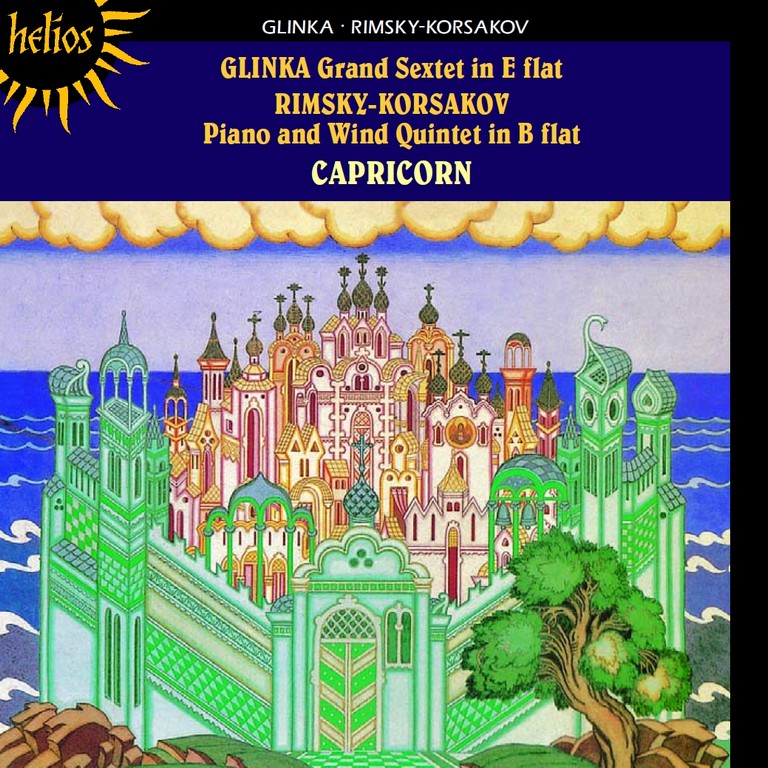
Glinka: Grand Sextet; Rimsky-Korsakov: Quintet


�Some of the most joyously delightful music that you will ever hear� --American Record Guide

�Rimsky�s youthful quintet is a thoroughly diverting piece � like a garrulous but endearing friend whose loquacity is readily borne for the sake of his charm and good nature� --Penguin Stereo Record Guide


�Two delightful rarities --The Musical Times

�Captivating� --Hi-Fi News

'A most striking performance, beautifully modulated, elegantly phrased... very well recorded indeed' --BBC Record Review

Jumat, 05 Juli 2013

Tchaikovsky & Mussorgsky: Symphony No. 2 'Little Russian', Pictures at an Exhibition


�The Musorgsky pieces are superbly performed...Bare Mountain's hair-raising opening sounding genuinely menacing rather than brash, and every cackle of the witches as impersonated by strings and woodwind brought to vivid life. Pictures, too, is a triumph, with Ravel's orchestration telling in every vignette.� --BBC Music Magazine, February 2012 *****
Gramophone Magazine Editor's Choice - March 2012


�If there's a single distinguishing feature of this generously filled disc it's Karabits's determination to convey the grass-roots spirit of the themes which breathe life into these pieces...Characteristically, he is more mindful of the pianistic cragginess of Mussorgsky's Pictures at an Exhibition than of Ravel's finesse...Karabits is big-boned and earthy, and positively encourages coarser-grained sonorities from his Bournemouth Symphony Orchestra.� --Gramophone Magazine, March 2012

�Karabits encourages the players to dig deep into the music, pounding out the rhythms sturdily, in the Tchaikovsky especially, rather than bustling ahead nervously. At 82 minutes this is a generous, as well as an enjoyable CD.� --The Observer, 30th October 2011

�Strong rhythmic definition, clarity of orchestral texture and firmly controlled impetus give the Tchaikovsky a definite boost. Karabits coaxes a ripe, full sound from the Bournemouth players and encourages broad bowings from the strings that add weight to the sonority. Equally he allows for individual instrumental colours to tell..Karabits is an inspired architect.� --The Telegraph, 11th November 2011 ****

�[it] has everything we expect from a Tchaikovsky interpreter of the Moscow school � colour, sweep, majesty, but not a whiff of indulgence. The Bournemouth orchestra responds with style and drive � all wind sections in superlative form � and a symphony that is often dismissed as a poor relation of its better known successors comes across as a masterpiece� --Financial Times, 26th November 2011 *****

Muffat: Armonico Tributo


'The best English baroque chamber music record I have ever heard' --Hi Fi News

'I have always found the music indescribably beautiful' --Fanfare, USA

'Can one find a more hauntingly beautiful piece than the Passacaglia from Sonata No 5? --Goldberg


Rabu, 03 Juli 2013

Mozart, Copland & Kats-Chernin: Works for Clarinet & Orchestra


�... In recent efforts, Collins has cultivated a cleaner sound to accompany his always impressive musicianship and technique, and his playing here is some his best. His timbre is clear and resonant, and while it naturally has a touch of British flavour, it is disciplined and colourful. The Mozart is beautiful, perceptive, and breathtaking; the Copland is intimate and exuberant; and the Kats-Chernin is urgent an raucous. His expressive risk-taking is enjoyable, too, from the joyful decorations in the Mozart to the sassy pitch-bending in the Kats-Chernin... The Swedish Chamber orchestra plays with seemingly effortless aplomb and professionalism, no matter the composer or the century.� --American Record Guide, May/June 2013


�...Throughout, Michael Collins is in his element, relishing every twist and turn of the music�s consistently imaginative invention ... Michael Collins is just as at home here [Copelands�s Concerto] as he is in the Mozart and Kats-Chernin, directing the Swedish Chamber Orchestra with idiomatic panache.� --Gramophone magazine, March 2013

 �...Collins is better integrated with the orchestra than virtually any of his predecessors ... The sense of spontaneous, organic interplay between clarinet and orchestra is most welcome ... Few recordings on either period or modern instruments manage this interplay as well � and few orchestras, period or modern, manage a collective sense of phrasing as convincing as the Swedish Chamber Orchestra here, making this a strong recommendation. The ravishing opening pages of the Copeland are given their full quota of swoon and the collective phrasing of the orchestral strings is consistently excellent - again the chamber-music qualities of this performance are a particular delight... Collins proves a strong and committed advocate for the work...� --International Record Review, January 2013

Fernando Lopes-Gra�a: Piano Concertos Nos. 1 and 2


The music of Fernando Lopes-Gra�a, one of the most significant Portuguese composers of the twentieth century, went through several phases of development. Though rooted in folk music, it absorbed influences not only from much earlier composers such as Scarlatti and Seixas, but from contemporaries such as Bart�k. These influences are potent in the Piano Concerto No. 1 of 1940, a highly personal, atmospheric and superbly orchestrated work imbued with bittersweet romanticism. Though the Iberian Baroque permeates its finale, the Piano Concerto No. 2 is a much darker and more ambivalent work, marking a new milestone in his development.


Fernando Lopes-Gra�a collected the folksongs of his native Portugal, and his early compositions were strongly influenced by such music. Later he was influenced by Bart�k and Stravinsky. The Piano Concertos represent two of his most contrasting and absorbing works. The First is richly atmospheric, the post-War Second Concerto dark. Both embed Spanish Baroque music, but are in no way pastiche works. Their appeal is direct due to imaginative orchestration and strong themes.

Selasa, 02 Juli 2013

Nielsen: The Symphonies


Includes previously unreleased recordings of concert overtures Helios and Saga-Dream, and the �pastoral scene� Pan and Syrinx with the Lahti Symphony orchestra.

The performance of the Fourth was described as �of great character and fire� in International Record Review, the recording of Symphony No.5 called �a first choice, full of intensity� in BBC Music Magazine

�great music, exciting music-making� --The Times, 17th December 2010


"This is a compelling box, offering a Nielsen cycle of uncommon distinction and authority. It would be hard to better V�nsk�s performances not least for their consistency. BIS has a deserved reputation for the quality of its recorded sound and these discs are in the finest traditions of the house. There�s good bloom on the sound and just the right amount of resonance and, above all, the sound is crystal clear, allowing an abundance of detail to register very naturally. The sound is completely truthful and realistic and there�s an impressive dynamic range, which allows the biggest climaxes to register thrillingly.

Collectors who have not yet sampled Osmo V�nsk� in Nielsen should hasten to make good that omission by investing in this excellent set." -- John Quinn, MusicWeb International